Bhagavad Gita Quotes: Key Verses in Edwin Arnold's Translation
The best Bhagavad Gita quotes in Sir Edwin Arnold's public-domain 1885 translation, The Song Celestial, with chapter and verse references and plain notes.
In this article
- What is the Bhagavad Gita?
- About this translation
- Bhagavad Gita quotes on action and karma
- Bhagavad Gita quotes on death and the eternal self
- Bhagavad Gita quotes on the mind
- Bhagavad Gita quotes on the steady sage
- Bhagavad Gita quotes on devotion and love
- Bhagavad Gita quote on dharma
- Key terms
- How to read the Bhagavad Gita
- Read the Gita in Soulfeed
The best-known Bhagavad Gita quotes are about acting well without clinging to results, the deathless self, and a steady mind. In Sir Edwin Arnold’s public-domain translation of 1885, Krishna says: “Let right deeds be thy motive, not the fruit which comes from them” (2.47); “Never the spirit was born; the spirit shall cease to be never” (2.20); and “Steadfast a lamp burns sheltered from the wind; Such is the likeness of the Yogi’s mind” (6.19). Below are the key verses of the Gita in Arnold’s English, with chapter and verse references and short notes on what they mean.
What is the Bhagavad Gita?
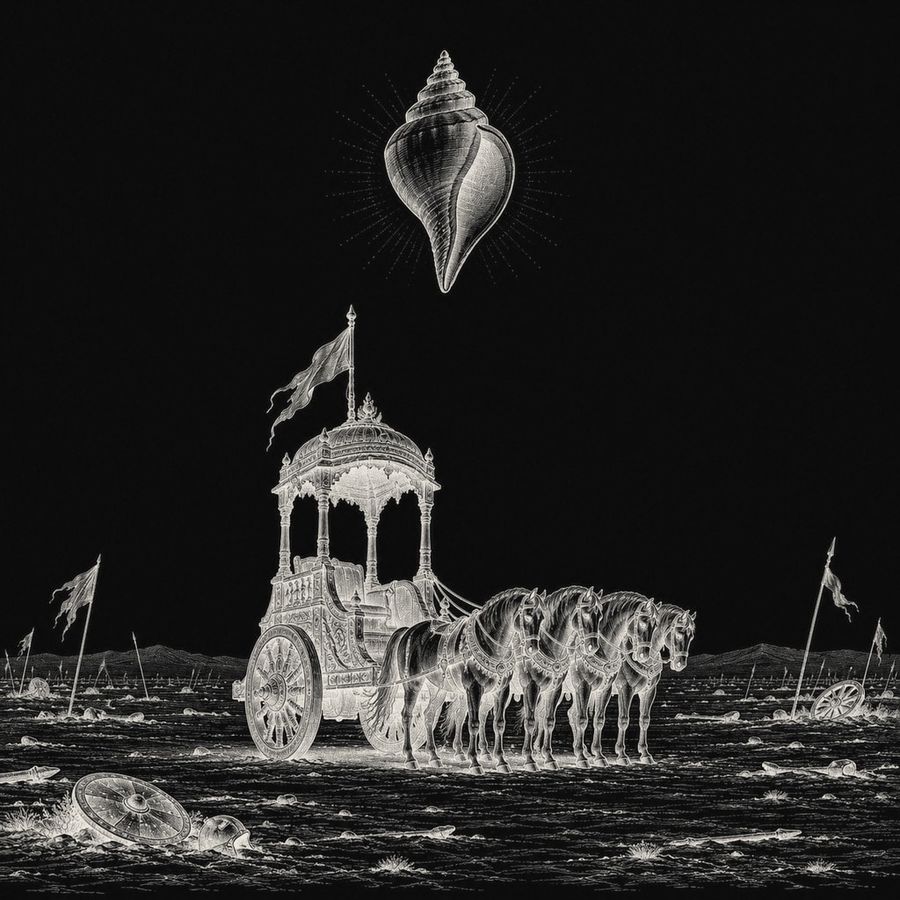
The Bhagavad Gita, “the Song of the Lord”, is a 700-verse Sanskrit poem in 18 chapters. It forms part of the Mahabharata, India’s great epic. On the battlefield of Kurukshetra, just before a war between two branches of one family, the warrior prince Arjuna loses his nerve. He sees teachers, cousins and friends on the other side and lets his bow fall. His charioteer is Krishna, who is revealed as the divine Lord, and the Gita is their conversation: on duty and action, the nature of the self, the paths of knowledge, work and devotion, and how to live with a steady mind.
It is one of the central texts of Hinduism and has been read far beyond it. It is short enough to read in an afternoon and deep enough for a lifetime.
About this translation
Sir Edwin Arnold, an English poet and journalist, published his verse translation, The Song Celestial, in 1885. It is musical and occasionally grand, and it introduced the Gita to many English readers. Mohandas Gandhi wrote in his autobiography that he first read the Gita as a student in London, in Arnold’s translation.
Arnold did not number the verses, because he wrote the Gita as one continuous English poem. For each quote below we give the chapter and the standard verse number it corresponds to, so you can look it up in any edition. Arnold uses “Yog” for yoga.
Bhagavad Gita quotes on action and karma
But thou, want not! ask not! Find full reward
Of doing right in right! Let right deeds be
Thy motive, not the fruit which comes from them.
And live in action! Labour! Make thine acts
Thy piety, casting all self aside,
Contemning gain and merit; equable
In good or evil: equability
Is Yog, is piety!Bhagavad Gita 2.47 to 2.48, tr. Sir Edwin Arnold (1885)
This is the heart of karma yoga, the path of action. Krishna does not tell Arjuna to stop acting or to stop caring. He tells him to do what is right because it is right, and to let go of his grip on the outcome. “Equability”, staying level in success and failure, is itself the practice.
Better thine own work is, though done with fault,
Than doing others’ work, ev’n excellently.Bhagavad Gita 18.47, tr. Sir Edwin Arnold (1885)
Your own path, done imperfectly, is better than someone else’s done perfectly. The Gita makes the same point in chapter 3 (3.35), and it is a relief to anyone who has tried to live another person’s life.
Detaching end from act, with act content,
The world of sense can no more stain his soul
Than waters mar th’ enamelled lotus-leaf.Bhagavad Gita 5.10, tr. Sir Edwin Arnold (1885)
The lotus grows in muddy water, yet water slides off its leaves. The same image appears in the Buddhist Dhammapada (verse 401), a sign of how much the two traditions share.
Bhagavad Gita quotes on death and the eternal self
Never the spirit was born; the spirit shall cease to be never;
Never was time it was not; End and Beginning are dreams!
Birthless and deathless and changeless remaineth the spirit for ever;
Death hath not touched it at all, dead though the house of it seems!Bhagavad Gita 2.20, tr. Sir Edwin Arnold (1885)
Nay, but as when one layeth
His worn-out robes away,
And taking new ones, sayeth,
“These will I wear to-day!”
So putteth by the spirit
Lightly its garb of flesh,
And passeth to inherit
A residence afresh.Bhagavad Gita 2.22, tr. Sir Edwin Arnold (1885)
Chapter 2 begins with Arjuna in grief, unwilling to fight. Krishna’s first teaching is about what does not die. The “spirit” here translates atman (the true self), which the Gita says is not the body and is not touched by the body’s end.
Bhagavad Gita quotes on the mind
Hero long-armed! beyond denial, hard
Man’s heart is to restrain, and wavering;
Yet may it grow restrained by habit, Prince!
By wont of self-command.Bhagavad Gita 6.35, tr. Sir Edwin Arnold (1885)
Arjuna has just complained that the mind is as hard to hold as the wind. Krishna does not argue. He agrees, and then gives the practical answer: habit, practice, a little at a time.
Steadfast a lamp burns sheltered from the wind;
Such is the likeness of the Yogi’s mind
Shut from sense-storms and burning bright to Heaven.Bhagavad Gita 6.19, tr. Sir Edwin Arnold (1885)
The soul of the ungoverned is not his,
Nor hath he knowledge of himself; which lacked,
How grows serenity? and, wanting that,
Whence shall he hope for happiness?Bhagavad Gita 2.66, tr. Sir Edwin Arnold (1885)
As smoke blots the white fire, as clinging rust
Mars the bright mirror, as the womb surrounds
The babe unborn, so is the world of things
Foiled, soiled, enclosed in this desire of flesh.Bhagavad Gita 3.38, tr. Sir Edwin Arnold (1885)
Rumi uses the same image of a rusted mirror for a heart that cannot reflect the light; see our Rumi quotes from the Masnavi.
Bhagavad Gita quotes on the steady sage
In sorrows not dejected, and in joys
Not overjoyed; dwelling outside the stress
Of passion, fear, and anger; fixed in calms
Of lofty contemplation…Bhagavad Gita 2.56, tr. Sir Edwin Arnold (1885)
Arjuna asks how to recognise a person of steady wisdom. The answer is not someone who feels nothing, but someone who is not thrown around by what they feel.
Let each man raise
The Self by Soul, not trample down his Self,
Since Soul that is Self’s friend may grow Self’s foe.Bhagavad Gita 6.5, tr. Sir Edwin Arnold (1885)
In plainer words: lift yourself up by your own effort and do not put yourself down, because you can be your own best friend or your own worst enemy.
Bhagavad Gita quotes on devotion and love
Whoso shall offer Me in faith and love
A leaf, a flower, a fruit, water poured forth,
That offering I accept, lovingly made
With pious will.Bhagavad Gita 9.26, tr. Sir Edwin Arnold (1885)
The path of devotion, bhakti, asks for nothing grand. A leaf is enough if it is given with love.
Who hateth nought
Of all which lives, living himself benign,
Compassionate, from arrogance exempt,
Exempt from love of self, unchangeable
By good or ill; patient, contented, firm
In faith, mastering himself, true to his word…Bhagavad Gita 12.13 to 12.14, tr. Sir Edwin Arnold (1885)
Precious thou art to Me; right well-beloved!
Bhagavad Gita 18.64, tr. Sir Edwin Arnold (1885)
Near the very end, after seventeen chapters of philosophy, Krishna says something simple and tender. Many readers find this the most moving line in the book.
Bhagavad Gita quote on dharma
When Righteousness
Declines, O Bharata! when Wickedness
Is strong, I rise, from age to age, and take
Visible shape, and move a man with men,
Succouring the good, thrusting the evil back,
And setting Virtue on her seat again.Bhagavad Gita 4.7 to 4.8, tr. Sir Edwin Arnold (1885)
Key terms
- Dharma: duty, right order, the way things ought to be; also one’s own rightful path.
- Karma: action, and the consequences that follow from it.
- Yoga (“Yog” in Arnold): union or discipline; the Gita describes several yogas, including action, knowledge and devotion.
- Atman: the true self, which the Gita says is unborn and undying.
- Bhakti: loving devotion to the divine.
- Krishna and Arjuna: the divine teacher and the warrior prince whose dialogue makes up the Gita.
How to read the Bhagavad Gita
Start with chapter 2. It contains much of the Gita’s core teaching, and many readers return to it for years. Then read a chapter at a sitting, slowly, noticing which of the paths (action, knowledge or devotion) speaks to you most. Do not be put off by the battlefield setting. Arjuna’s crisis is anyone’s: a hard duty, divided loyalties and a mind that wants to run.
Soulfeed’s Bhagavad Gita: 7 days plan offers a week with the Song Celestial on action, duty and freedom, one passage a day with a plain explanation and a question to reflect on. The Vedanta & Yoga path also includes the Upanishads (Max Müller) and Swami Vivekananda’s Raja Yoga (1896), which has its own seven-day plan. Our guide to building a daily spiritual reading habit explains how to choose.
The Gita’s teaching on acting without clinging to results sits close to the Stoics. Compare 2.47 with Epictetus and Marcus Aurelius in our Marcus Aurelius quotes.
Read the Gita in Soulfeed
Soulfeed is an iPhone app that turns your scroll into a calm feed of spiritual teachings. The Bhagavad Gita is in its library in Arnold’s 1885 translation with a clear modern rendering, the meaning of each passage, key terms such as dharma and atman, and a reflection question. Learn more in What is Soulfeed? or visit the Soulfeed home page.
Frequently asked questions
What is the most famous verse of the Bhagavad Gita?
Verse 2.47, on acting without attachment to results, is the most quoted. In Sir Edwin Arnold's 1885 translation it reads: 'Let right deeds be thy motive, not the fruit which comes from them.'
What does the Bhagavad Gita say about death?
Chapter 2 teaches that the true self is not born and does not die. Arnold renders verse 2.20 as 'Never the spirit was born; the spirit shall cease to be never' and compares death to setting aside worn-out clothes for new ones (2.22).
Which Bhagavad Gita translation is public domain?
Sir Edwin Arnold's verse translation, The Song Celestial, published in 1885, is in the public domain. Many modern translations and commentaries are still in copyright.
How many chapters and verses does the Bhagavad Gita have?
The Bhagavad Gita has 18 chapters and about 700 verses. It forms part of the Bhishma Parva of the Mahabharata, the great Sanskrit epic.
Why don't Arnold's lines have verse numbers?
Arnold translated the Gita as a continuous English poem and did not number the verses. On this page, each quote gives the chapter and the standard Sanskrit verse number it corresponds to, so you can find it in any edition.