Tao Te Ching Quotes: Laozi's Best Lines, With Chapter Numbers
The most loved Tao Te Ching quotes in James Legge's public-domain 1891 translation, with chapter numbers and plain notes on water, emptiness and wu wei.
In this article
The Tao Te Ching quotes people return to most are about softness, emptiness and letting things be: “The highest excellence is like (that of) water” (chapter 8), “Who can (make) the muddy water (clear)? Let it be still, and it will gradually become clear” (chapter 15), and “the journey of a thousand li commenced with a single step” (chapter 64). Below are the best-loved lines from Laozi’s short classic, all quoted in James Legge’s 1891 public-domain translation with their chapter numbers, plus a few plain notes on what they mean.
About the Tao Te Ching
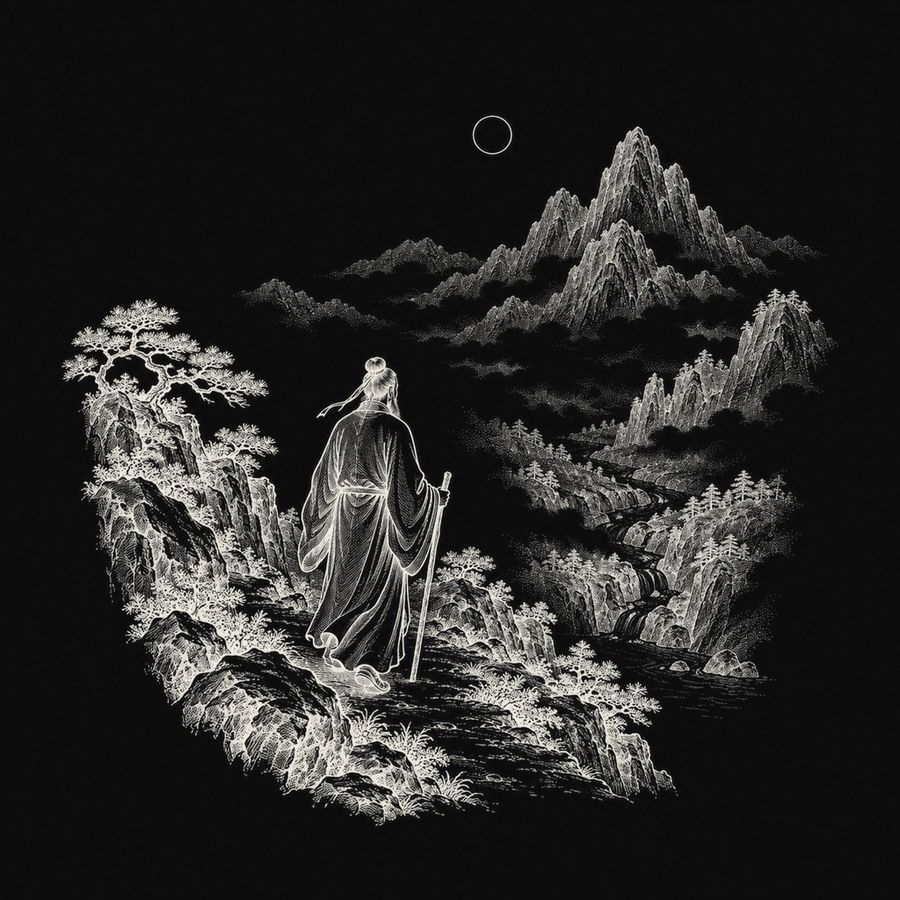
The Tao Te Ching (also written Daodejing) is a short book of 81 chapters, traditionally attributed to Laozi, an archivist of ancient China. Its title is often translated as “The Classic of the Way and its Virtue”. In about five thousand Chinese characters, it describes the Tao, the nameless Way that runs through all things, and how a person (or a ruler) can live in harmony with it.
James Legge, a Scottish scholar who spent decades translating the Chinese classics, published his version in 1891 in the Sacred Books of the East. It is careful and literal. Legge puts words he has added for sense in round brackets, so you can see exactly where the Chinese ends and the English help begins. We have kept his brackets.
Many of the Tao Te Ching quotes passed around online come from modern English versions that are still in copyright, or are paraphrases that drift far from the text. Everything on this page is Legge’s wording, checked against the published text.
The Tao that cannot be named
The Tao that can be trodden is not the enduring and unchanging Tao. The name that can be named is not the enduring and unchanging name.
Tao Te Ching 1, tr. James Legge (1891)
The book begins by admitting it cannot do what it sets out to do. Whatever the Tao is, words can point at it but not hold it. Everything after this line is offered in that spirit.
He who knows (the Tao) does not (care to) speak (about it); he who is (ever ready to) speak about it does not know it.
Tao Te Ching 56, tr. James Legge (1891)
To know and yet (think) we do not know is the highest (attainment); not to know (and yet think) we do know is a disease.
Tao Te Ching 71, tr. James Legge (1891)
Tao Te Ching quotes about water
Water is the book’s favourite teacher. It is soft, it goes to low places that others avoid, and yet it wears down stone.
The highest excellence is like (that of) water. The excellence of water appears in its benefiting all things, and in its occupying, without striving (to the contrary), the low place which all men dislike. Hence (its way) is near to (that of) the Tao.
Tao Te Ching 8, tr. James Legge (1891)
Who can (make) the muddy water (clear)? Let it be still, and it will gradually become clear. Who can secure the condition of rest? Let movement go on, and the condition of rest will gradually arise.
Tao Te Ching 15, tr. James Legge (1891)
Chapter 15 may be the most useful line in the book for a busy mind. You cannot scrub muddy water clean. You can only stop stirring it.
There is nothing in the world more soft and weak than water, and yet for attacking things that are firm and strong there is nothing that can take precedence of it…
Tao Te Ching 78, tr. James Legge (1891)
Every one in the world knows that the soft overcomes the hard, and the weak the strong, but no one is able to carry it out in practice.
Tao Te Ching 78, tr. James Legge (1891)
The softest thing in the world dashes against and overcomes the hardest; that which has no (substantial) existence enters where there is no crevice. I know hereby what advantage belongs to doing nothing (with a purpose).
Tao Te Ching 43, tr. James Legge (1891)
Emptiness and usefulness
The thirty spokes unite in the one nave; but it is on the empty space (for the axle), that the use of the wheel depends. Clay is fashioned into vessels; but it is on their empty hollowness, that their use depends.
Tao Te Ching 11, tr. James Legge (1891)
A wheel, a bowl, a room: each is useful because of the space inside it. Chapter 11 is a quiet argument for leaving some room in a day, a calendar or a mind.
It is better to leave a vessel unfilled, than to attempt to carry it when it is full. If you keep feeling a point that has been sharpened, the point cannot long preserve its sharpness.
Tao Te Ching 9, tr. James Legge (1891)
The Tao is (like) the emptiness of a vessel; and in our employment of it we must be on our guard against all fulness.
Tao Te Ching 4, tr. James Legge (1891)
Wu wei: acting without forcing
Wu wei is the Tao Te Ching’s most famous idea and its most misunderstood. It does not mean laziness. It means action that is not forced, not grasping, not done to be seen. Legge often renders it as doing nothing “with a purpose” or “for the sake of it”.
The Tao in its regular course does nothing (for the sake of doing it), and so there is nothing which it does not do.
Tao Te Ching 37, tr. James Legge (1891)
He who devotes himself to learning (seeks) from day to day to increase (his knowledge); he who devotes himself to the Tao (seeks) from day to day to diminish (his doing).
Tao Te Ching 48, tr. James Legge (1891)
Therefore the sage manages affairs without doing anything, and conveys his instructions without the use of speech.
Tao Te Ching 2, tr. James Legge (1891)
Small beginnings
(The master of it) anticipates things that are difficult while they are easy, and does things that would become great while they are small. All difficult things in the world are sure to arise from a previous state in which they were easy, and all great things from one in which they were small.
Tao Te Ching 63, tr. James Legge (1891)
The tree which fills the arms grew from the tiniest sprout; the tower of nine storeys rose from a (small) heap of earth; the journey of a thousand li commenced with a single step.
Tao Te Ching 64, tr. James Legge (1891)
This is the source of “the journey of a thousand miles begins with a single step”. A li is a traditional Chinese measure of distance, a good deal shorter than a mile, but the point survives the conversion.
Knowing yourself, and enough
He who knows other men is discerning; he who knows himself is intelligent. He who overcomes others is strong; he who overcomes himself is mighty. He who is satisfied with his lot is rich; he who goes on acting with energy has a (firm) will.
Tao Te Ching 33, tr. James Legge (1891)
There is no guilt greater than to sanction ambition; no calamity greater than to be discontented with one’s lot; no fault greater than the wish to be getting. Therefore the sufficiency of contentment is an enduring and unchanging sufficiency.
Tao Te Ching 46, tr. James Legge (1891)
Legge sets some chapters as rhymed verse, as in this passage from chapter 44:
Who is content
Needs fear no shame.
Who knows to stop
Incurs no blame.
From danger free
Long live shall he.Tao Te Ching 44, tr. James Legge (1891)
Humility and gentleness
He who stands on his tiptoes does not stand firm; he who stretches his legs does not walk (easily). (So), he who displays himself does not shine; he who asserts his own views is not distinguished.
Tao Te Ching 24, tr. James Legge (1891)
He is free from self-display, and therefore he shines; from self-assertion, and therefore he is distinguished; from self-boasting, and therefore his merit is acknowledged; from self-complacency, and therefore he acquires superiority.
Tao Te Ching 22, tr. James Legge (1891)
But I have three precious things which I prize and hold fast. The first is gentleness; the second is economy; and the third is shrinking from taking precedence of others.
Tao Te Ching 67, tr. James Legge (1891)
Man at his birth is supple and weak; at his death, firm and strong. (So it is with) all things. Trees and plants, in their early growth, are soft and brittle; at their death, dry and withered.
Tao Te Ching 76, tr. James Legge (1891)
The sage does not accumulate (for himself). The more that he expends for others, the more does he possess of his own; the more that he gives to others, the more does he have himself.
Tao Te Ching 81, tr. James Legge (1891)
The last chapter of the book ends on giving. Having started by saying the Tao cannot be put into words, Laozi closes with something anyone can do.
Key terms
- Tao (道 dào): the Way; the nameless source and pattern of all things.
- Te (德 dé): virtue or power; the quality a person has when they move with the Tao.
- Wu wei (無為 wúwéi): non-forcing action; doing without grasping.
- The sage: the book’s ideal person, who leads by example, keeps low and does not boast.
How to read the Tao Te Ching
The chapters are short enough to read one a day, and many readers do exactly that, returning to the start when they reach chapter 81. Read a chapter slowly, twice. Pick one image (water, an empty bowl, a seedling) and carry it into your day. Do not worry if a chapter seems obscure; some are about governing a state, and their meaning for a single life is left to you.
If you want company along the way, Soulfeed’s The Tao in 30 days plan takes you through Laozi’s short chapters a day at a time, each with a plain explanation and a question to reflect on. Our guide to building a daily spiritual reading habit explains how plans work. The Taoist path in Soulfeed also includes the Zhuangzi (Herbert Giles, 1889) and the Book of Lieh Tzu (Lionel Giles, 1912), whose stories bring the same ideas down to earth.
For a different tradition saying a similar thing, compare chapter 15 on muddy water with the Dhammapada’s verses on the mind, or chapter 33 on overcoming yourself with Dhammapada 103.
Read the Tao Te Ching in Soulfeed
Soulfeed is an iPhone app that turns your scroll into a quiet feed of spiritual teachings. The Tao Te Ching is in its library in Legge’s translation with a modern rendering, meaning, key terms such as Tao and wu wei, and a question to sit with for every passage. Learn more in What is Soulfeed? or visit the Soulfeed home page.
Frequently asked questions
What is the most famous quote from the Tao Te Ching?
The opening line of chapter 1 is the best known. In James Legge's 1891 translation it reads: 'The Tao that can be trodden is not the enduring and unchanging Tao. The name that can be named is not the enduring and unchanging name.'
Is 'The journey of a thousand miles begins with a single step' from the Tao Te Ching?
Yes, it comes from chapter 64. Legge translates it as 'the journey of a thousand li commenced with a single step'. A li is a traditional Chinese unit of distance, shorter than a mile.
Who wrote the Tao Te Ching?
Tradition attributes it to Laozi (also spelled Lao Tzu), said to be a keeper of archives in ancient China. Little is known about him for certain, and many scholars think the text grew over time.
What does wu wei mean?
Wu wei is often translated as 'non-action' or 'effortless action'. It does not mean doing nothing at all. It means acting without forcing, the way water finds its way around a stone. Legge often renders it as doing nothing 'with a purpose' or 'for the sake of it'.
Which Tao Te Ching translation is public domain?
James Legge's 1891 translation, published in the Sacred Books of the East series, is in the public domain and free to quote. Many popular modern versions are still under copyright.